How Can We Celebrate All Women in This Women’s History Month?
Every March, International Women’s Day and Women’s History Month roll around, inviting us to reflect on and celebrate the achievements, struggles, and power of women. But… which women are we really celebrating? Whose stories get told—and whose are conveniently left out?
It’s easy to post a quote, wear a purple ribbon, or retweet a graphic that says “empowered women empower women.” But are we taking the time to reflect on which women are being centered in our conversations—and which women are consistently erased?
Because let’s be honest: mainstream feminism still has a long way to go.
As we mark this Women’s History Month, it’s essential that we go beyond tokenistic gestures. We must recognise and honour all women—including those from historically and systemically marginalised backgrounds—whose voices and contributions have not only been overlooked, but often deliberately silenced.
It’s not just about adding diversity for diversity’s sake. It’s about reimagining feminism itself—dismantling the structures within it that continue to prioritise whiteness, cisgender identities, middle-class comfort, and able-bodied norms. If we only amplify the experiences of the most privileged women, how can we claim to be fighting for equality?
What is Intersectionality—and Why Does it Matter?
“There is no thing as a single-issue struggle because we do not live single-issue lives.”
Intersectionality is more than just a buzzword. It’s a framework that helps us understand how systems of oppression are interconnected—and how the experiences of people at the intersections of these systems are often uniquely compounded.
Coined by Black feminist scholar Kimberlé Crenshaw in 1989, intersectionality explains how race, gender, class, disability, and other identities collide to create deeply complex realities. Crenshaw used the term to highlight how Black women’s experiences were being ignored—both in feminist spaces that centered white women, and in anti-racist spaces that centered Black men.
So when we say we’re fighting for gender justice, but fail to fight for racial justice, disability justice, economic justice, and trans liberation, we’re not actually being feminist—we’re just reproducing the same hierarchies under a new name.
Mainstream Feminism Has a Representation Problem
Take, for example, the now-famous moment when actress Emma Watson and actor Benedict Cumberbatch along with many other celebrities proudly donned T-shirts that read: “This is what a feminist looks like.” Sounds empowering, right?
Until it was revealed that the shirts were made by women working under exploitative conditions in a sweatshop in Mauritius, earning 62p an hour.
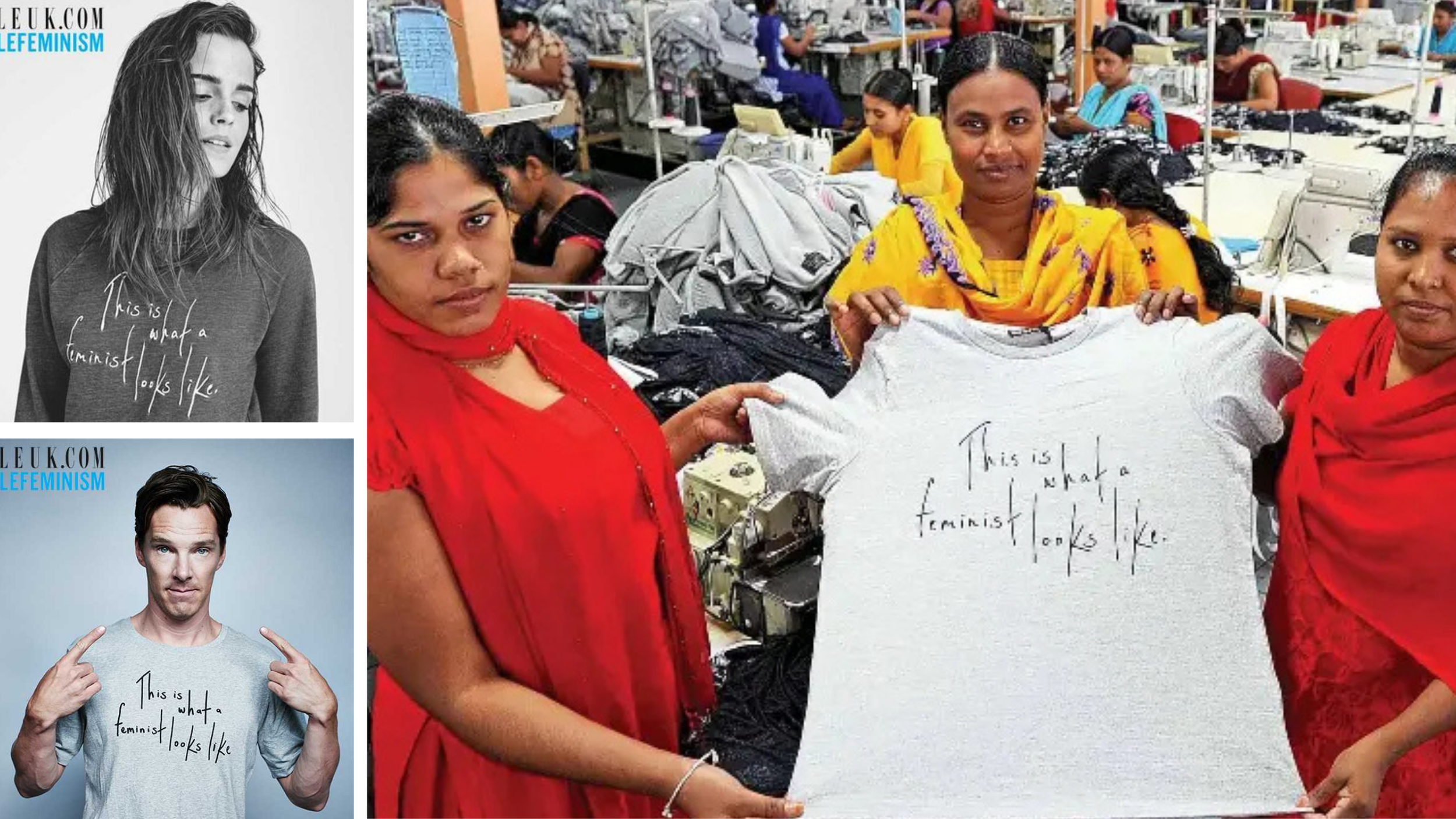
So what does this tell us?
It tells us that feminism cannot stop at catchy slogans and merch. Feminism that is comfortable, performative, and uncritical of capitalism, racism, or imperialism is not feminism—it’s branding.
This same logic applies when we celebrate famous white women CEOs breaking glass ceilings while ignoring the women cleaning those offices for poverty wages. Or when we host panels on gender equity that feature only cisgender women. Or when we frame climate leadership without acknowledging the Indigenous, Black, and brown women on the frontlines who are putting their lives on the line to protect land, water, and communities.
It’s not enough to invite marginalised women to the table. We need to ask: Who built the table? Who has always been left out of the room? And who gets silenced when they speak up, even after finally being invited in?
What Can We Do to Celebrate All Women?
Let’s be real: true feminism is messy, uncomfortable, and deeply challenging. But it’s also powerful, healing, and transformative—when done right.
Here are some ways we can begin to celebrate all women this Women’s History Month (and every month):
1. Decenter whiteness and the “default” woman
Too often, feminism is portrayed through the lens of the white, cisgender, able-bodied, middle-class woman. This narrow framing erases the lives of so many others—especially Black and Indigenous women, trans women, disabled women, migrant women, and working-class women. Ask yourself: Whose experiences do I most often hear about? And whose am I not even looking for?
2. Listen to those most impacted by patriarchy
This means going beyond tokenism. Follow and support women at the margins, share their work, cite their ideas, and—most importantly—believe them when they name harm, even if it implicates people or systems you admire.
3. Challenge exploitation in all forms
That includes questioning how your clothes are made, whose labour makes your feminism possible, and what “progress” really looks like when it’s built on the backs of others.
4. Learn and unlearn actively
Feminism is a lifelong journey, not a destination. Keep reading, keep listening, keep growing. And remember: when you know better, do better.
5. Make space—and then step back
Sometimes, being a good ally means stepping aside so others can speak. It means not co-opting or speaking over women with less privilege than you. Make space—and protect it.
Recommended Resources to understand intersectionality:
For those who would like to explore intersectionality further, here are some accessible resources:
Kimberlé Crenshaw’s TED Talk: The Urgency of Intersectionality – A compelling introduction to the concept and why it matters.
Article: What is Intersectionality? by Learning for Justice – A beginner-friendly breakdown of the term and its applications. Teaching at the Intersections | Learning for Justice
Book: Moya Bailey “Hood Feminism”. Hood Feminism challenges mainstream feminist narratives by centering the experiences and needs of marginalised women—particularly Black women and Women of colour.
Podcast: “Intersectionality Matters!”, by Kimberlé Crenshaw. In each episode, Crenshaw engages with activists, academics, and thought leaders to explore how race, gender, class, and other systems of oppression intersect in shaping social and political issues.
This Women’s History Month (and every day) let’s celebrate ALL women.